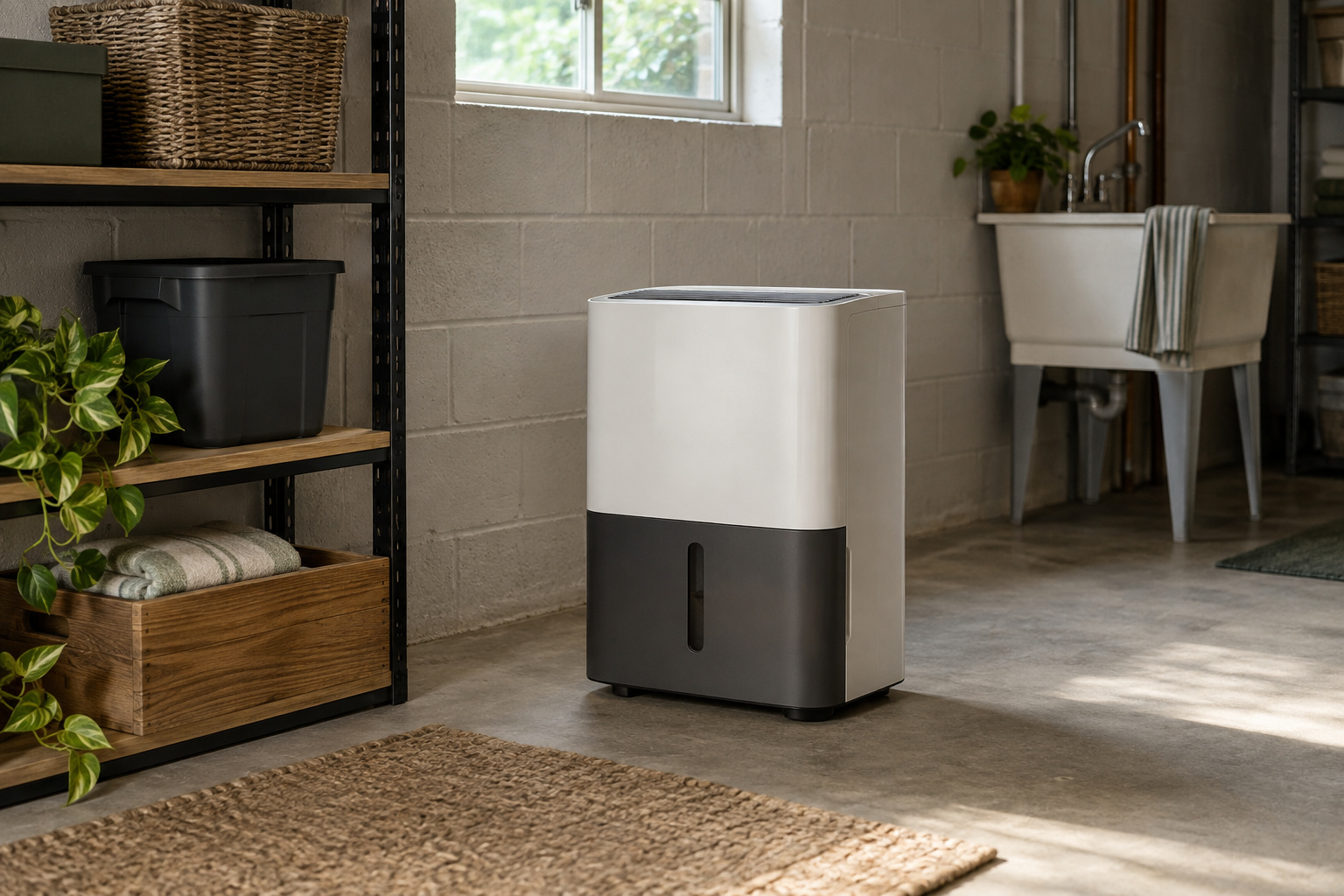
A basement dehumidifier is one part of a moisture-control plan. The useful first question is not which listing advertises the largest coverage area. It is whether your basement has a manageable airborne-moisture problem, an active water-entry problem, or both. Build a short requirements sheet before comparing products so that convenience features do not distract you from installation limits.
Describe the problem before choosing equipment
Walk through the basement after rain and again during ordinary weather. Record where you notice dampness, whether it is concentrated at one wall, and whether water appears around a window, pipe or floor joint. Take photographs for your own records. You are collecting observations, not diagnosing the building from a smell alone. A dehumidifier does not repair a leaking pipe or divert rainwater away from a foundation.
The EPA moisture guide puts moisture control alongside correction of the water problem. If your notes show recurring seepage, give that repair its own task and budget. Read our damp-basement troubleshooting guide before treating a larger appliance as the default solution. Do not enter standing water to adjust electrical equipment.
Measure the conditions that influence selection
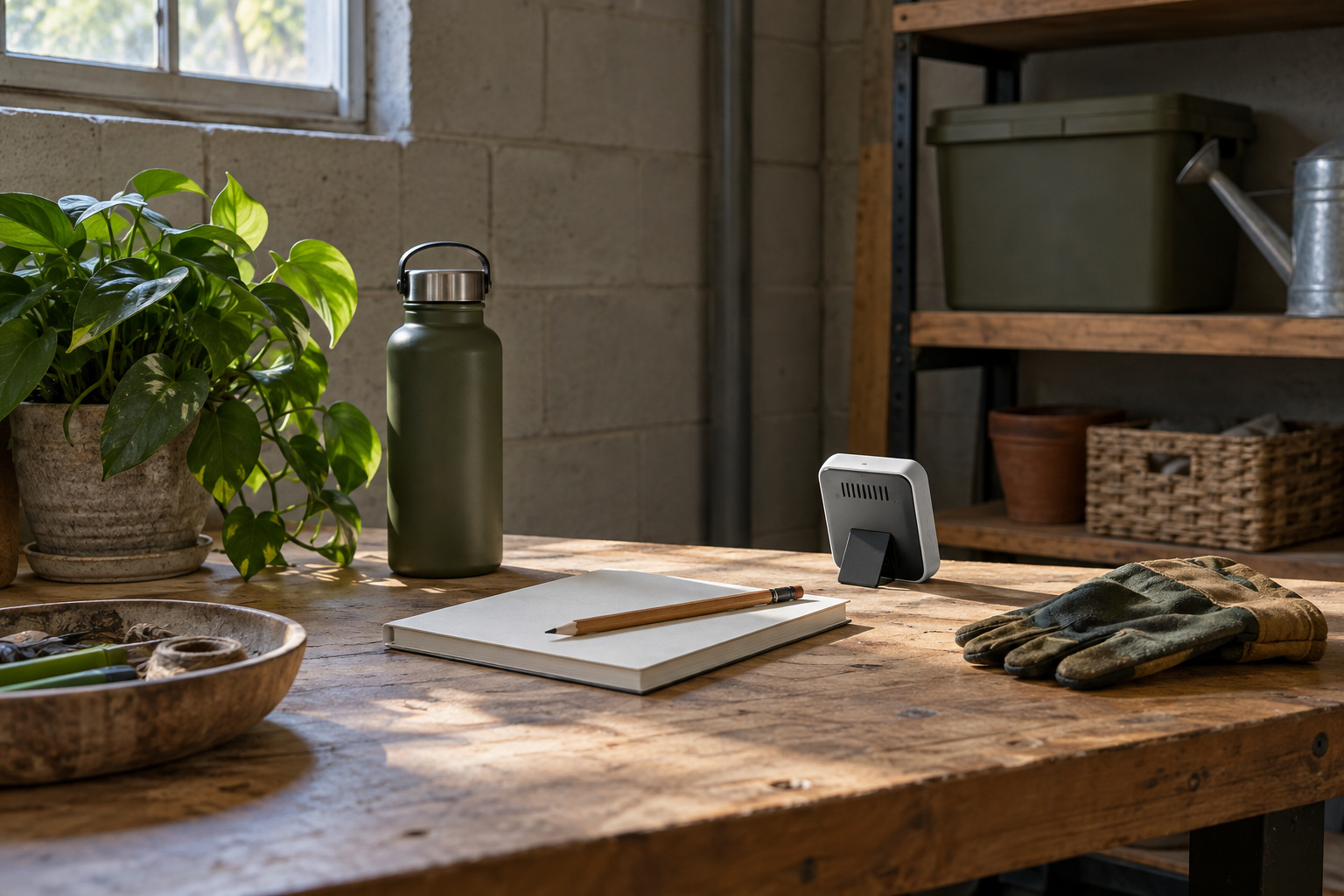
Record relative humidity and temperature at representative locations. A single reading beside the warm discharge grille tells you little about an enclosed storage room. Note the time, weather, whether the laundry is running and whether exterior doors are open. Repeat the observations so you can distinguish an isolated spike from a persistent pattern.
Measure the connected floor area and sketch partitions. Include the rooms you actually expect one appliance to serve, rather than automatically using the entire house area. Closed doors and restricted circulation matter. The humidity-target guide explains how to use the readings without chasing every display fluctuation. Your purchase notes should contain area, recurring humidity range and the coolest temperature you expect during operation.
Compare capacity on a consistent basis
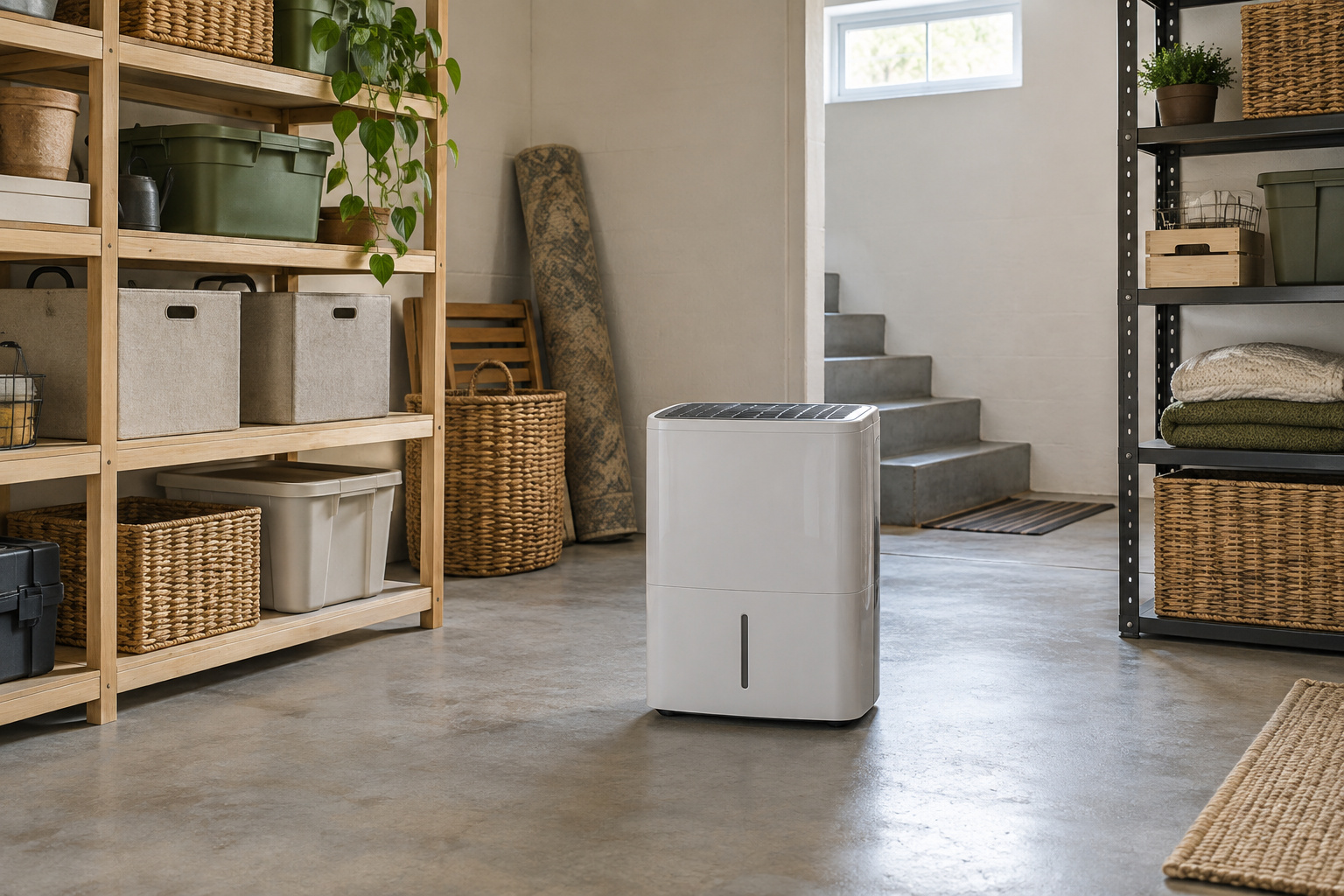
Water-removal capacity is normally expressed in pints per day; bucket volume is a separate specification. A large bucket can make emptying less frequent without making the refrigeration system remove more water per day. Keep those two lines separate in your notes, particularly when a listing puts both numbers close together.
Use the sizing guide and our selection tool to identify a broad starting range. ENERGY STAR bases its guidance on both floor area and moisture conditions. Avoid comparing an old capacity figure with a newer figure unless the rating basis is clear. Floor-coverage claims are a reason to investigate a listing, not proof that it will control your particular basement.
If efficiency is part of your shortlist, use our ENERGY STAR verification guide to match the full model identifier before comparing IEF values. A badge in a listing title is not enough.
| Item | What to record |
|---|---|
| Problem | Airborne moisture, active water entry, or both |
| Conditions | Relative humidity, temperature, connected floor area |
| Capacity | Pints per day, kept separate from bucket volume |
| Water disposal | Bucket, gravity hose or documented pump |
| Exact model | Temperature range, clearances, drain diagram, electrical |
Choose the water-disposal method early
Imagine using the appliance during an ordinary busy week. Can you comfortably reach and empty the bucket? Is there a suitable drain below the outlet? Would the discharge need to rise to a sink or other approved destination? These questions decide whether a basic bucket, a gravity hose or a documented pump arrangement is practical.
A pump adds its own tubing, activation and maintenance instructions. A gravity connection needs a route that actually descends; a loop over a doorway is not gravity drainage. Read gravity drain versus pump before paying for a feature you cannot use. Include the hose route and service access on your floor sketch. Keep water handling separate from electrical cords and connections.
Make an exact-model purchase checklist
Open the manufacturer's manual for the full model identifier, including its suffix. Find:
- Temperature: the operating-temperature range.
- Clearances: the required clearances.
- Drainage: the drainage diagram.
- Electrical: the electrical instructions.
If the seller's title and the manual disagree, stop treating the feature as confirmed. Ask the manufacturer or seller to resolve the mismatch before purchasing, and save the response with your notes.
Our appliance shortlist is a research starting point. Its ratings come from documented specifications because we have not physically tested these listings or verified a complete, comparable performance dataset. Check the chosen Amazon variant, supplied hose, warranty channel and current seller separately. After installation, keep your original observations and compare later readings under similar conditions. That record is more useful than assuming the lowest possible setting is always the right one.
Work through a realistic buying example
Suppose your notes describe a connected basement, a separate closed storage room and a floor drain near the laundry. Begin with the connected area and measured conditions, then check whether the storage room shares air in normal use. Do not quietly add that room to the appliance coverage assumption just because both spaces are on the same level. Put its separate humidity observations beside the main-room readings. Next, trace the possible gravity hose route from a location that meets the candidate manual requirements. If that route crosses the only walkway, reconsider placement before deciding that a pump is necessary. Compare the additional parts and inspection work for each workable arrangement. Only after those checks should you compare conveniences such as app controls or fan modes. Your final decision sheet should explain why one candidate remains: supported room conditions, an identified manual, usable access and a documented drainage arrangement. Keep a second candidate only if it passes the same checks. This turns a long product list into a defensible purchase decision without pretending that an editorial ranking can replace your installation details.